
Ring-Down Circuits in Broadcast Television
A ring-down is a dedicated telephone circuit between two locations. There are no phone numbers and nothing to dial. Pick up either handset and the telephone at the other end rings.
For college football broadcasts, ring-downs commonly connect the television production truck to three locations:
- Home SID
- Away SID
- Replay booth
SID stands for Sports Information Director. The producer uses the Home and Away SID ring-downs to request players for postgame interviews. The Replay ring-down provides a direct connection between the replay booth and the truck. It may be used during setup and testing or when the replay booth needs to request a particular replay angle during the game.
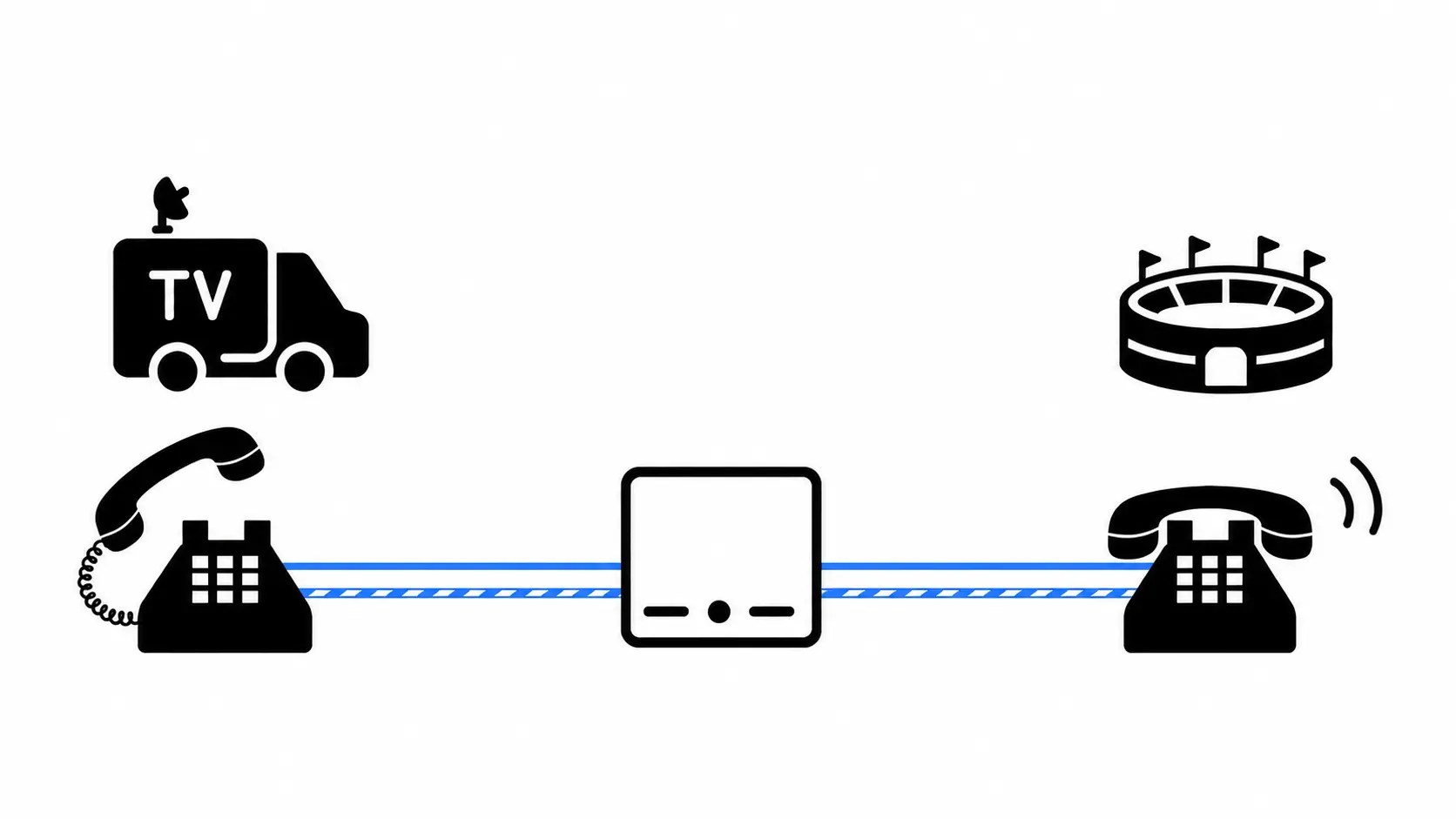
How a Ring-Down Works
Each circuit has a dedicated telephone handset at both ends. In the production truck, the telephones are usually labeled Home SID, Away SID and Replay. Matching handsets are placed at the appropriate locations inside the stadium.
When the circuit is working correctly, either end can initiate the call. Pick up the Home SID telephone in the truck and the telephone at the Home SID location rings. Pick up the telephone at the Home SID location and the matching telephone in the truck rings.
There is no dial tone and no number to remember. Pick up one telephone and the other one rings.
Why Use a Ring-Down Instead of Intercom?
The people using the stadium end of these circuits do not need to listen to production intercom for the entire game.
The Home SID, Away SID and replay official are not part of the television crew’s party line. They only need a direct connection to the truck when someone has a specific reason to call.
With a ring-down, the telephone stays quiet until it is needed. When it rings, the person picks it up, has the conversation and hangs it back up. There is no headset to wear, no beltpack to monitor and no intercom panel to understand.
It also keeps each conversation separate. A call to the Home SID does not interrupt the Away SID, Replay or anyone listening to production communications.
An intercom panel could be programmed with a dedicated point-to-point key, but that adds equipment, programming and an unfamiliar device for someone outside the broadcast crew. A telephone already makes sense to everyone: it rings, you answer it.
Something Has to Make the Telephones Ring
Two telephones connected by a pair of wire will not create a ring-down circuit by themselves. A telephone-line simulator or ring-down unit is needed between them. This unit powers the circuit, detects when one telephone goes off-hook and rings the telephone at the other end.
Sometimes the production truck supplies the ring-down equipment. Other times, the stadium has a permanent system already installed. Viking is one manufacturer commonly encountered in these systems.
The stadium may present the circuit on a standard RJ11 telephone jack. It may also be delivered as a bare pair of wires.
If the pair needs to be extended, XLR cable can be used with XLR-to-bare-wire adapters. Pins 2 and 3 carry the telephone pair. The truck should have the telephones, ring-down equipment, butt set and adapters needed for the show. It is still useful for the A2 to have a wire stripper and a small screwdriver for adapters that use screw terminals.
Polarity Matters
This is the part that can waste a lot of time if you do not know to look for it.
The ring-down systems commonly used in broadcast are sensitive to the polarity of the telephone pair. If Tip and Ring are reversed, the telephones may not ring in either direction. Everything can appear to be connected correctly, but neither telephone does anything.
If a ring-down does not ring, reverse the pair and test it again before taking the entire system apart.
On a blue telephone pair, this may mean swapping the solid-blue conductor with the blue-and-white conductor. Tip and Ring simply trade places.
It takes a few seconds to try and may solve what appeared to be a completely dead circuit.
Installing and Testing the Ring-Downs
The broadcast A2 normally installs the handsets at the Home SID, Away SID and Replay locations.
Do not assume that a telephone is ready because it is sitting on a desk and connected to a jack. Every circuit needs to be tested in both directions using the actual handsets that will be used during the game.
Test From the Stadium Location
- Pick up the handset.
- Confirm that the correct telephone rings in the truck.
- Have someone answer it.
- Confirm clear two-way communication.
Test From the Production Truck
- Pick up the matching truck handset.
- Confirm that the correct telephone rings at the stadium location.
- Verify clear two-way communication again.
This proves more than simple continuity. It confirms that the circuit rings in both directions and that the two ends are connected to the correct telephones.
Test for Game Conditions
A ring-down can technically work and still be useless during the game.
Check the ringer volume while you are at the stadium location. It needs to be loud enough to hear once the stadium is full. Also check the volume in the earpiece. A telephone that sounds fine in a quiet booth during setup may be difficult to use once the game starts.
Before leaving the location, confirm all of the following:
- The stadium location can ring the truck.
- The truck can ring the stadium location.
- Two-way conversation is clear.
- The ringer is loud enough for game conditions.
- The earpiece is loud enough for game conditions.
- Both ends are clearly labeled.
- Home SID rings Home SID.
- Away SID rings Away SID.
- Replay rings Replay.
The last three are worth checking carefully. All of the handsets look alike, and crossed or poorly labeled circuits may not become obvious until someone tries to use them.
Troubleshooting a Dead Ring-Down
If the telephones do not ring, start with the easiest possibility:
Reverse Tip and Ring, then test the circuit again.
If that does not fix it, start at the ring-down unit and work outward. Do not start at opposite ends of the stadium and guess about everything in between.
Connect known-good handsets directly to both ports of the ring-down unit. Confirm that taking either telephone off-hook rings the other telephone and that clear audio passes in both directions.
Once the center of the system is known to be working, add one cable segment at a time. Test again after every cable, adapter or house pair is added.
Work outward toward the production truck in one direction and toward the stadium location in the other. When the circuit stops working, the problem is in the last part that was connected.
A telephone butt set is useful for following the circuit and narrowing down the problem. The final test should still be completed with the assigned handsets. A butt set may prove that the circuit is present, but it does not tell you whether the actual telephone rings loudly enough or whether its earpiece will be usable during the game.
Common Ring-Down Problems
- Tip and Ring are reversed.
- A house pair or cable segment is bad.
- An adapter is wired incorrectly.
- Home and Away SID circuits are crossed.
- A telephone or circuit is labeled incorrectly.
- The ringer volume is too low.
- The earpiece volume is too low.
The harder part is finding the problem without changing several things at once.
Start at the ring-down unit, prove that the center works and then build the circuit outward one piece at a time. That keeps a bad house pair from looking like a bad telephone—and keeps a reversed pair from turning into an hour of unnecessary troubleshooting.
Simple, Direct and Still Useful
A ring-down is old telephone technology doing one very specific job.
It gives someone outside the television crew a private, direct connection to the production truck without putting them on intercom. They do not need a headset, a beltpack or instructions about which key to press.
The telephone rings. They answer it.
For something so simple, ring-downs can be surprisingly stubborn during setup. Check the polarity, test both directions, turn up the volume and make sure every telephone rings the location printed on its label.
Once that is done, they generally sit there quietly until someone actually needs them—which is exactly the point.